
Action games are a broad video game genre built around direct player interaction, physical challenges, movement, coordination, and reaction time. Depending on the title, players may fight opponents, shoot targets, jump across platforms, explore environments, solve problems, or complete missions. The genre includes several subgenres, so not every action title plays in the same way.
For beginners, understanding the genre can make it easier to choose games that match their interests and preferred play style. This guide explains what Action games are, how they work, their major types, important features, different platforms, beginner tips, and how the genre has developed over time.
What Are Action Games?
It is generally defined by physical challenges that require skills such as hand-eye coordination, motor control, and reaction time. Players usually have direct control over a character or other game element and must respond to events happening during gameplay.
The genre covers many different experiences. A platformer may focus on jumping and movement, a fighting game may emphasize close combat, and a shooter may test aiming and quick responses. These categories can also overlap with other genres.
What Makes a Game an Action Game?
A game is commonly associated with the action genre when success depends significantly on direct physical interaction. Players may need to move quickly, attack, dodge, aim, jump, or respond to changing obstacles.
Not every action title has the same structure. Some use linear levels, while others provide larger areas to explore. Some focus heavily on combat, while others combine action with puzzles, exploration, or storytelling. This broad definition explains why the genre contains so many different styles.
The Importance of Skill, Timing, and Reaction
Skill, timing, and reaction are central to many Action games. A player may need to recognize an attack, avoid an obstacle, land a jump, or perform an attack at the correct moment.
However, reaction speed is not the only skill involved. Pattern recognition, positioning, movement, and knowledge of game mechanics can also influence performance. The specific balance depends on the individual title.
How Do Action Games Work?
Core Gameplay Mechanics
The mechanics of it define what players can do and how the game responds. Common mechanics include movement, jumping, attacking, blocking, dodging, aiming, collecting items, and interacting with the environment.
Combat systems can become particularly detailed. They may include different attacks, combinations, defensive actions, weapons, abilities, or enemy behaviors. Game-development guidance emphasizes that responsive input and balanced combat are important considerations when designing action mechanics.
Movement, Combat, and Interaction
Movement allows players to position characters and navigate environments. In some games, movement itself is the main challenge; in others, it supports combat and exploration.
Combat can involve close-range attacks, ranged weapons, special abilities, or combinations of these systems. Interaction can also include opening objects, collecting items, activating mechanisms, or using environmental elements.
The result is a gameplay loop in which the player observes a situation, chooses an action, receives feedback, and adjusts their approach.
Challenges, Objectives, and Player Progression
Action games often give players objectives such as reaching an area, defeating enemies, surviving an encounter, collecting an item, or completing a mission.
Progression can occur through new levels, abilities, equipment, characters, areas, or increasingly difficult challenges. Some games use straightforward level progression, while others allow players to explore larger environments and choose their objectives.
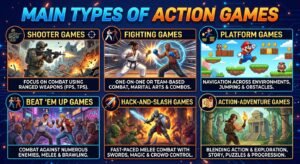
Main Types of Action Games
Shooter Games
Shooter games focus on ranged combat and commonly require players to aim at targets or opponents. First-person shooters present the action from a first-person viewpoint, while third-person shooters place the camera behind the playable character.
Shooters can also include different modes, objectives, and multiplayer systems. Their mechanics may emphasize accuracy, movement, positioning, and reaction time.
Fighting Games
Fighting games focus on direct combat between characters. Matches commonly involve attacks, defensive moves, special techniques, and carefully timed inputs. Many fighting games also include competitive multiplayer.
Learning a fighting game can involve understanding character moves, timing, spacing, combinations, and defensive options.
Platform Games
Platform games, or platformers, generally center on movement through environments using actions such as jumping and climbing. Players may need to avoid hazards, defeat enemies, or reach specific locations.
Precision is often important because the player must judge distance, timing, and movement while navigating platforms.
Beat ’Em Up Games
Beat ’em ups, sometimes called brawlers, typically involve fighting groups of enemies while moving through a level. The player may use punches, kicks, weapons, or other close-range attacks.
This format differs from traditional fighting games because the player commonly progresses through an environment and encounters multiple opponents rather than competing in a single character-versus-character match.
Hack-and-Slash Games
Hack-and-slash games emphasize real-time melee combat, often using swords, blades, or similar weapons. Depending on the title, players may use combos, dodges, special attacks, or different weapons.
The term can overlap with other categories, including action role-playing and character-action games, so individual titles may use several genre labels.
Action-Adventure Games
Action-adventure games combine action mechanics with adventure elements such as exploration, puzzles, story, dialogue, and item systems.
This combination makes action-adventure one of the broader hybrid categories. A player may fight enemies in one section, explore an environment in another, and solve a puzzle to progress.
Key Features of Action Games
Fast-Paced Gameplay
Many Action games are designed around immediate interaction. Players may need to react to enemies, hazards, moving platforms, or changing situations.
The pace can vary, though. Some titles deliberately slow encounters down so that positioning and timing become more important than rapid button presses.
Combat and Enemy Encounters
Combat is an important feature of many action titles, but it is not universal. Combat systems may include melee attacks, ranged attacks, defensive moves, combos, or special abilities.
Enemy design can also influence gameplay. Different opponents may require players to change their positioning, timing, or attack strategy.
Responsive Controls
Responsive controls are important because players need to understand how their inputs affect the game. GameDeveloper’s analysis of combat mechanics emphasizes recognizing player inputs and producing meaningful changes in the game world.
Responsiveness is not necessarily about making every action instantaneous. Feedback and consistency also matter. A well-designed system can communicate when an input has been recognized even if an action has a deliberate animation or timing window.
Timing and Reaction-Based Challenges
Timing can determine whether a player successfully attacks, blocks, dodges, jumps, or avoids an obstacle. Some games require rapid reactions, while others give players more time to observe patterns and plan their actions. This variety allows the genre to support both fast and deliberate styles of play.
Levels, Missions, and Objectives
Levels and missions give structure to gameplay. Objectives might include defeating opponents, reaching a destination, surviving a sequence, finding an item, or completing a story-related task.
Some games use clearly separated stages, while others connect objectives through larger environments.
Character Abilities and Progression
Character abilities can give players additional ways to approach challenges. These may include new attacks, movement abilities, weapons, defensive techniques, or special skills.
Progression systems can also introduce stronger or more varied options as the player advances, creating a sense of development without requiring every title to use the same system.
Understanding Action-Adventure Games
How Action and Adventure Elements Combine
Action-adventure design brings physical challenges together with adventure-style elements. Instead of focusing entirely on combat, these games can combine fighting, exploration, puzzles, story, dialogue, and item collection.
This hybrid structure allows gameplay to change from one activity to another while maintaining a connected experience.
Combat, Exploration, and Puzzles
A player may explore an area, discover an obstacle, search for an item, solve a puzzle, and then enter a combat encounter. These systems can support one another rather than existing as completely separate activities.
That combination is one reason action-adventure games can feel different from games focused almost entirely on combat.
Storytelling and Character Progression
Storytelling can play an important role in action-adventure games. Characters, dialogue, environments, and player actions can help move the narrative forward.
Progression may involve new abilities, equipment, areas, or story events. The exact system varies by game, so action-adventure should be treated as a broad category rather than a single fixed formula.
What Makes Action Games Exciting?
Fast and Interactive Gameplay
One reason players may enjoy Action games is the direct relationship between input and outcome. Players actively control movement and actions rather than simply observing events.
Skill-Based Challenges
Many titles reward players for learning mechanics and improving execution. A difficult encounter can become easier when players understand enemy patterns, movement, timing, and available abilities.
Variety in Combat and Missions
Variety can come from different enemies, environments, weapons, objectives, and abilities. Combining these elements can prevent every encounter from requiring exactly the same response.
Sense of Progression and Achievement
Progression can provide a clear feeling of accomplishment. Players may advance through levels, unlock abilities, defeat difficult opponents, or improve their understanding of the game’s mechanics.
Replayability
Replay value can come from mastering mechanics, improving performance, trying different approaches, completing additional challenges, or playing with other people.
Not every game is designed around repeated play, but systems such as competitive modes, multiple difficulty levels, unlockable content, and complex combat can encourage players to return.
Action Games on Different Platforms
Action Games on PC
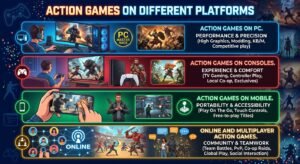
PCs support many action genres, including shooters, platformers, fighting games, and action-adventure titles. Players may use keyboards and mice, controllers, or other supported input devices depending on the game.
Action Games on Consoles
Consoles offer a wide range of action experiences. Official platform catalogs include fighting, platforming, shooting, and action-adventure titles, with some supporting both local and online multiplayer.
Action Games on Mobile
Mobile devices can support action titles through touch controls, virtual buttons, motion input, or compatible controllers. Developers may adapt control systems to work effectively on smaller touchscreens.
Online and Multiplayer Action Games
Multiplayer adds competitive or cooperative interaction. Players may compete directly, cooperate on missions, participate in team-based modes, or complete challenges together. The exact experience depends on the game’s design, supported player count, and online features.
How to Choose the Right Action Game
Choose a Preferred Gameplay Style
Start by deciding what interests you most. If you enjoy aiming, a shooter may be appropriate. If you prefer close combat, a fighting or hack-and-slash title may be more suitable. Players who enjoy exploration can look toward action-adventure games.
Consider Difficulty and Learning Curve
Different games require different levels of practice. Beginners may prefer titles with tutorials, adjustable difficulty, or straightforward controls. Checking the game’s official description and available difficulty options can help set realistic expectations.
Single-Player vs. Multiplayer
Consider whether you want to play alone or with others. Single-player titles may emphasize campaigns, exploration, and personal progression, while multiplayer games can focus on competition, cooperation, or both.
Check Platform and Hardware Requirements
Always check the supported platform and hardware requirements before choosing a game. Official product pages are generally the best place to confirm compatibility and available features.
Consider Story, Combat, and Exploration
Think about how much importance you place on each element. Some players want frequent combat, while others prefer a balance between combat, exploration, puzzles, and storytelling.
Tips for Beginners Playing Action Games
Learn the Controls
Spend time learning basic movement, attacks, defense, interaction, and other important controls. A strong understanding of the control system makes later challenges easier to manage.
Practice Movement and Timing
Practice individual mechanics before combining them. Learning when to move, attack, dodge, or defend can make difficult encounters more predictable.
Understand Enemy Patterns
Watch how enemies behave. Recognizing repeated attacks or openings can help you decide when to attack and when to defend.
Start With an Appropriate Difficulty
If multiple difficulty levels are available, choose one that allows you to learn the mechanics without making every encounter overwhelming.
Learn From Mistakes and Keep Practicing
Failure can provide useful information. Instead of repeating the same approach, identify what caused the mistake and change your timing, positioning, or strategy.
How Action Games Have Evolved
From Classic Arcade Games to Modern Titles
The action genre has roots in early video games and arcade experiences. Early titles often focused on direct physical challenges, simple controls, scoring, and short gameplay sessions.
Over time, developers expanded these ideas with longer levels, more detailed characters, stories, exploration, progression, and complex mechanics.
The Development of 3D Action Games
Three-dimensional environments expanded how players could move and explore game worlds. Instead of navigating primarily across a flat screen, players could interact with spaces containing greater depth, vertical movement, and more complex layouts.
The Rise of Online and Multiplayer Gameplay
Online connectivity has allowed action titles to support competitive and cooperative experiences involving multiple players.
Multiplayer can add new challenges because players must respond not only to programmed opponents but also to human-controlled characters and changing team situations.
How Modern Technology Is Changing Action Games
Modern development tools allow creators to combine detailed environments, animation, combat systems, progression mechanics, and online features.
Technology can expand what developers build, but fundamental gameplay principles remain important. Players still need clear controls, useful feedback, understandable rules, and meaningful challenges.
Read more: Timebears com Website Review 2026: Features and Details
What Is the Future of Action Games?
More Immersive Gameplay
Future Action games may continue experimenting with movement, interaction, environmental systems, and feedback. The direction will depend on the hardware and design tools available to developers.
Advances in Graphics and Game Technology
Improved hardware and development technology can support more detailed environments, animation, lighting, physics, and visual effects.
However, better graphics alone do not guarantee better gameplay. Controls and mechanics remain central to the player’s experience.
Smarter Enemies and Game Systems
Enemy behavior can become more varied through different attack patterns, movement systems, and combat roles. Developers can use these systems to create encounters that require players to observe and adapt.
New Approaches to Multiplayer and Interactive Worlds
Multiplayer design can continue combining action mechanics with cooperative and competitive experiences. Existing games already demonstrate different approaches to online competition, cooperation, and shared gameplay.
Final Verdict
Action games are not limited to one style of play. They include shooters, fighting games, platformers, beat ’em ups, hack-and-slash titles, and action-adventure experiences, with many games combining elements from several categories.
The common thread is direct player interaction. Movement, timing, coordination, combat, reaction, and control can all contribute to the experience. Some games demand quick responses, while others emphasize deliberate timing, exploration, or learning complex mechanics.
For players, the best starting point is to identify the type of gameplay they enjoy. From there, factors such as difficulty, platform, multiplayer options, combat style, exploration, and story can help narrow the choices.
FAQs About Action Games
What are action games?
Action games are video games centered on physical challenges such as movement, coordination, combat, and reaction time. They include several subgenres and can overlap with adventure, role-playing, and other categories.
What are the main types of action games?
Major types include shooter, fighting, platform, beat ’em up, hack-and-slash, and action-adventure games. Some games combine multiple categories.
What makes it different from other genres?
They generally place greater emphasis on direct physical interaction and real-time challenges. Players may need to move, aim, attack, defend, jump, or react quickly.
Are action games suitable for beginners?
Many are, although difficulty varies. Games with tutorials, practice options, or adjustable difficulty can provide a more accessible introduction.
Can it be played on mobile devices?
Yes. Mobile platforms support many action titles using touch controls, virtual buttons, motion input, or compatible controllers.
What skills are useful for playing action games?
Useful skills include hand-eye coordination, timing, reaction, spatial awareness, pattern recognition, and familiarity with controls. The importance of each skill depends on the game.