
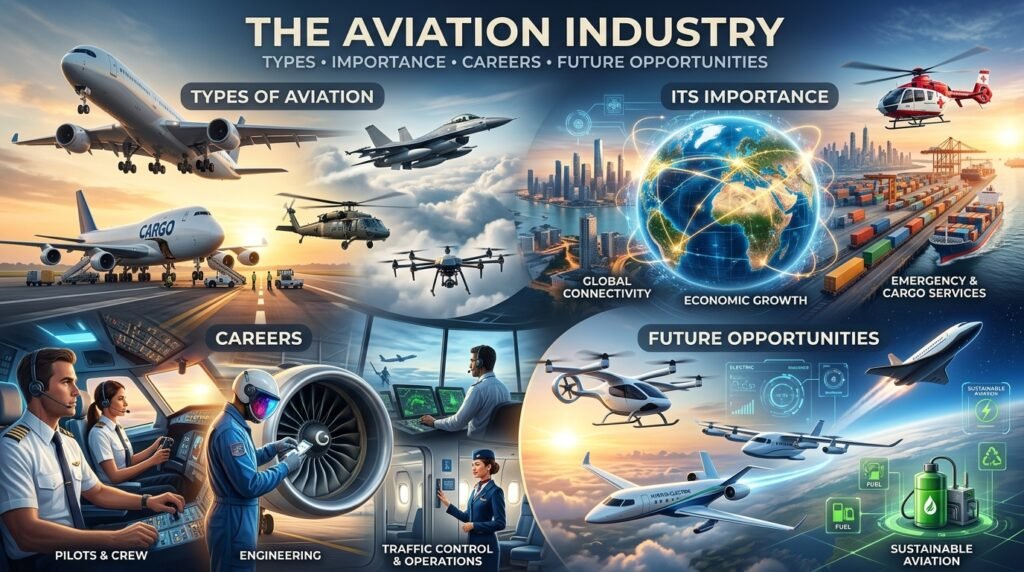
The aviation industry is one of the world’s most important transportation sectors. It connects people, businesses, countries, and markets through air travel and cargo transportation. The industry includes airlines, airports, aircraft manufacturers, maintenance organizations, air traffic services, and many supporting businesses.
Beyond transportation, aviation contributes to tourism, international trade, employment, and economic activity. At the same time, the industry is adapting to challenges such as operating costs, environmental concerns, supply-chain pressures, and changing technology.
What Is the Aviation Industry?
It is the broad network of organizations involved in operating, supporting, regulating, and developing aircraft and air transportation. It includes commercial airlines, general aviation operators, airports, manufacturers, maintenance providers, air navigation services, and regulators.
Different parts of the industry perform different functions. Airlines transport passengers and cargo, airports provide essential infrastructure, manufacturers build aircraft, and maintenance organizations keep aircraft in suitable operating condition.
How the Aviation Works
It works through coordination between many organizations. Before a commercial flight takes place, an airline must prepare the aircraft, crew, passengers, cargo, and flight plan while airport and air traffic services coordinate the operation.
Air traffic management helps aircraft move safely through controlled airspace. Communication, navigation, surveillance, and traffic-flow systems all contribute to the safe and efficient movement of aircraft.
Major Types of the Aviation Industry
Commercial Aviation
Commercial aviation involves air transportation provided as a business service. Airlines operate scheduled and other passenger or cargo services between different destinations. Commercial aviation includes activities such as passenger transportation, airline operations, airport services, ticketing, baggage handling, aircraft maintenance, and flight scheduling.
General Aviation
General aviation covers many civil aviation activities outside scheduled airline operations. It can include private flying, business aviation, flight training, recreational flying, aerial work, and other specialized operations. This part of the aviation industry serves individuals, businesses, training organizations, and specialized users with different transportation needs.
Military Aviation
Military aviation involves aircraft operated for defense and military purposes. It includes aircraft such as fighters, transport planes, helicopters, surveillance aircraft, and training aircraft. Military aviation has different objectives from commercial aviation, but it still depends on advanced aircraft systems, trained personnel, maintenance, navigation, and strict operational procedures.
Cargo and Freight Aviation
Cargo aviation transports goods by air. It can be particularly useful for time-sensitive, valuable, or specialized products that need relatively rapid transportation. Freight may be carried by dedicated cargo aircraft or in the cargo compartments of passenger aircraft. Air cargo is an important part of international supply chains and global trade.
Key Components of the Aviation Industry
Airlines and Aircraft Operators
Airlines are one of the most visible parts of the Aviation Industry. They manage aircraft fleets, routes, schedules, crews, passenger services, cargo operations, and many other activities. Airline operations also depend on maintenance, fuel services, airport facilities, safety systems, customer support, and regulatory compliance.
Airports and Aviation Infrastructure
Airports provide the infrastructure required for aircraft, passengers, and cargo. Important facilities include runways, taxiways, terminals, gates, baggage systems, cargo areas, and navigation equipment. Airports also require regular maintenance, planning, security, and technological improvements to support safe and efficient operations.
Aircraft Manufacturers
Aircraft manufacturers design and produce airplanes, helicopters, and related systems. Their work involves engineering, materials, propulsion, avionics, manufacturing, testing, and certification. Aircraft development is a complex process because manufacturers must meet detailed performance, safety, and regulatory requirements.
Air Traffic Control and Navigation
Air traffic control helps manage aircraft movements and maintain safe separation between aircraft. Controllers communicate with pilots and coordinate traffic during different stages of flight. Navigation and surveillance technologies provide information that helps aircraft and controllers understand their position and movement through the airspace.
Aviation Maintenance and Support Services
Aircraft require regular inspections, maintenance, repairs, parts, and technical support. Maintenance professionals help ensure that aircraft remain suitable for safe operation. Support services also include ground handling, fueling, catering, logistics, security, information technology, and other activities required to keep aviation operations running.
Why Is the Aviation Industry Important?
Supporting Global Travel and Tourism
Air transportation allows travelers to reach distant destinations within relatively short periods. This makes aviation an important part of international tourism. Air connectivity can help destinations attract visitors and allows travelers to access different countries, cities, attractions, and cultural experiences.
Connecting Businesses and Economies
Businesses rely on aviation to connect employees, customers, suppliers, and international markets. Air transportation can be particularly valuable when people or time-sensitive products need to travel long distances. By connecting different regions, aviation supports business relationships and international economic activity.
Creating Employment Opportunities
The Aviation Industry provides employment across many fields. Jobs can be found in airlines, airports, aircraft manufacturing, maintenance, air traffic services, security, administration, engineering, and customer service. Not every aviation career requires becoming a pilot. Many positions require technical, business, communication, management, or operational skills.
Supporting International Trade
Air cargo provides businesses with a fast transportation option for international shipments. It can be useful for products where transportation speed is important. The it therefore plays a role in connecting producers, suppliers, businesses, and customers across international markets.
How Has the Aviation Industry Evolved?
Early Development of Air Travel
Early aviation developed from experimental flying into organized transportation. Airmail services played an important role in the development of early commercial aviation. As aircraft technology improved, aircraft became more capable of carrying passengers and traveling longer distances, helping create the foundations of modern air transportation.
Growth of Commercial Aviation
Commercial aviation expanded as aircraft technology, airport infrastructure, navigation, and operational systems improved. Airlines developed routes connecting cities and countries. The growth of aviation also created demand for larger airports, better air traffic management, more advanced aircraft, and increasingly sophisticated passenger services.
Modern Aircraft and Aviation Technology
Modern aircraft combine advanced aerodynamics, engines, avionics, materials, communication systems, and navigation technology. Research continues to focus on improving aircraft efficiency and exploring new propulsion systems. These developments could influence how future aircraft are designed and operated.
Technology Transforming the Aviation Industry
Artificial Intelligence and Automation
Artificial intelligence is being researched for applications across aviation. Potential uses include data analysis, decision support, automation, maintenance-related systems, and operational planning. Because aviation is safety-critical, AI systems must be developed and evaluated carefully, with appropriate human oversight and regulatory consideration.
Advanced Aircraft Systems
Modern aircraft use increasingly sophisticated propulsion, avionics, navigation, communication, and control systems. Improvements in materials and aerodynamics can also contribute to aircraft efficiency. Research into electric, hybrid-electric, and other propulsion technologies is creating additional possibilities for future aviation.
Digital Airport Technology
Digital systems help airports manage information, passenger processes, baggage, security, aircraft operations, and communication. As airports become more connected, technologies such as automation, biometric systems, data platforms, and intelligent operational tools may become increasingly important.
Sustainable Aviation Technology
Sustainable aviation technology focuses on reducing the environmental impact of air transportation. Areas of research include more efficient aircraft, sustainable aviation fuel, alternative propulsion, and improved operational procedures. Different technologies are at different stages of development, so the future aviation system is likely to use a combination of approaches.
Careers in the Aviation Industry
Airline and Airport Jobs
Airlines and airports need employees for many functions, including customer service, operations, administration, logistics, security, information technology, and management. These roles demonstrate that aviation offers career opportunities beyond flight-related positions.
Pilots and Flight Crew
Pilots operate aircraft and are responsible for following applicable procedures, regulations, and safety requirements. Flight crews also include cabin professionals who support passenger service and safety. Pilot requirements vary by country and type of operation, but appropriate training, licensing, and experience are essential.
Aircraft Maintenance Careers
Aircraft maintenance professionals inspect, repair, service, and maintain aircraft and their systems. Their work is directly connected to aircraft airworthiness and operational safety. Maintenance careers can suit people interested in mechanical systems, electronics, engineering, and practical technical work.
Aviation Management and Administration
Aviation management includes areas such as airline operations, airport management, planning, finance, scheduling, safety, human resources, and customer experience. These professionals help coordinate people, resources, schedules, regulations, and business objectives within aviation organizations.
Air Traffic Control Careers
Air traffic controllers help manage aircraft movements and support safe and efficient traffic flow. They communicate with pilots and coordinate aircraft during different phases of flight. This career requires specialized training, concentration, communication skills, and the ability to work within established procedures.
Challenges Facing the Aviation Industry
Rising Operating Costs
Airlines face costs related to fuel, labor, aircraft ownership, maintenance, airport charges, and other services. Changes in these expenses can affect airline operations and financial performance. Supply-chain problems can also increase maintenance costs and make it more difficult for airlines to obtain aircraft, engines, and parts.
Environmental Concerns
Reducing aviation’s environmental impact is one of the industry’s major long-term challenges. Attention is focused on fuel efficiency, sustainable aviation fuel, improved aircraft, operational changes, and alternative propulsion. SAF can contribute to emissions reduction, but production and availability remain important challenges.
Safety and Security
Safety is fundamental to aviation. Aircraft, airports, air traffic systems, crews, maintenance teams, and regulators all contribute to managing operational risks. Security is also important because aviation infrastructure and aircraft must be protected against a range of potential threats.
Weather and Operational Disruptions
Weather can affect aircraft operations, airport infrastructure, and flight schedules. Storms, extreme temperatures, and other conditions may create delays or require operational changes. Climate-related risks are also encouraging aviation organizations to consider infrastructure resilience and adaptation.
Sustainability in the Aviation Industry
Reducing Aircraft Emissions
Reducing emissions requires improvements throughout the aviation system. Aircraft efficiency, engine technology, alternative fuels, operational procedures, and new propulsion concepts can all contribute. No single solution currently addresses every aviation sustainability challenge, so research continues across several technological areas.
Sustainable Aviation Fuel
Sustainable aviation fuel, or SAF, is an alternative to conventional fossil-based jet fuel. Its environmental benefits are assessed using lifecycle emissions. SAF is considered one pathway toward reducing aviation’s carbon footprint, although production capacity and availability remain important limitations.
More Efficient Aircraft
Aircraft efficiency can improve through better aerodynamics, engines, materials, and aircraft design. Newer aircraft can also incorporate technologies intended to reduce fuel consumption. However, aircraft supply-chain challenges can affect how quickly airlines can replace older aircraft with newer models.
Greener Airports and Operations
Airports can address sustainability through energy efficiency, infrastructure planning, ground-operation improvements, waste management, and climate adaptation. Greener aviation therefore involves not only aircraft but also the airports and other facilities that support air transportation.
Future Opportunities in the Aviation Industry
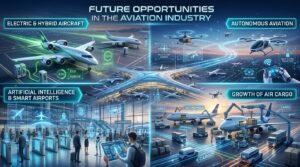
Electric and Hybrid Aircraft
Electric and hybrid-electric propulsion is an active area of aviation research. Researchers are investigating different configurations that could reduce fuel use and emissions. The practical application of these technologies will depend on factors such as aircraft size, battery and propulsion technology, safety, certification, and operating requirements.
Autonomous Aviation
Automation could influence future aviation by assisting pilots, operators, and other professionals with increasingly advanced functions. However, autonomous aviation must satisfy demanding safety and certification requirements. Human oversight and reliable technology will remain important considerations.
Artificial Intelligence and Smart Airports
AI may support future aviation through data analysis, operational decision-making, automation, maintenance, and passenger services. Smart airports can combine digital technologies and connected systems to improve the coordination of airport activities while maintaining appropriate safety, security, and privacy controls.
Growth of Air Cargo
Air cargo will continue to be an important part of global transportation. E-commerce, international trade, specialized products, and time-sensitive shipments can create demand for reliable air freight services. Future cargo growth will also depend on economic conditions, aircraft capacity, airport infrastructure, and global supply-chain patterns.
Read more: Technewztop 3D Explained: Features, Uses, and Benefits
How to Start a Career in the Aviation Industry
Choosing the Right Aviation Career
The first step is identifying which aviation area matches your interests and abilities. Options include flying, maintenance, engineering, airport operations, air traffic control, customer service, technology, and management. Researching job requirements before selecting a course or training program can help you understand the qualifications needed for your chosen career.
Education and Training
Education and training requirements depend on the occupation. Pilots need flight training and appropriate licenses, while maintenance professionals need technical training and relevant certification. Candidates should check the requirements established by the aviation authority and employers in their country because qualifications can vary between jurisdictions.
Gaining Experience and Certifications
Practical experience can be valuable in aviation because many roles involve technical knowledge, safety procedures, operational responsibilities, or specialized equipment. Relevant certifications can also be essential for regulated careers. Building experience through approved training, internships, entry-level positions, or other appropriate opportunities can help develop professional skills.
Final Thoughts
The Aviation Industry plays an important role in connecting people, businesses, and economies around the world. From airlines and airports to aircraft manufacturing, maintenance, and air traffic control, many sectors work together to keep air transportation operating safely and efficiently.
The future of it will be shaped by technology, sustainability, changing passenger needs, and new aircraft concepts. Artificial intelligence, sustainable aviation fuel, electric and hybrid aircraft, automation, and smarter airport systems are among the developments receiving increasing attention.
FAQs About Aviation Industry
1. What is the Aviation Industry?
It includes airlines, airports, aircraft manufacturers, maintenance providers, air traffic services, and other aviation-related organizations.
2. Why is it important?
It connects people and businesses while supporting tourism, international trade, employment, and global economic activity.
3. What careers are available in the Aviation Industry?
It offers careers for pilots, aircraft maintenance professionals, air traffic controllers, engineers, airport staff, managers, and technology specialists.
4. What challenges does it face?
The Aviation Industry faces challenges involving operating costs, environmental concerns, supply-chain issues, safety, security, and weather-related disruptions.
5. What is the future of the Aviation Industry?
The future of it may involve artificial intelligence, sustainable aviation fuel, smarter airports, advanced automation, and electric or hybrid aircraft.