
Mobile phones have changed the way people communicate, navigate, and access digital services. Location technology is now a normal part of smartphones, helping users find places, share their position, recover lost devices, and use applications that depend on location information.
This has also created interest in searches such as “Webparsab.com mobile location.” People may come across this phrase while looking for information about mobile-number tracking, phone location, GPS, or ways to determine the location of a device.
Webparsab.com has published blogs specifically discussing how location can be tracked using a mobile number. It explains several methods, including mobile networks, GPS, Google Location Sharing, tracking applications, WhatsApp Live Location, and mobile-number tracker websites or apps. It also emphasizes that location tracking should be performed legally and ethically.
What Is Webparsab.com Mobile Location?
It is a search phrase associated with Webparsab.com’s content about mobile-number location tracking and the wider subject of mobile-location technology.
Webparsab.com has published a guide titled “How to Track Location Using a Mobile Number? These Tips Will Be Useful for You.” The article explains that tracking a location through a mobile number is not as simple as entering a number and automatically receiving a precise location. It discusses several technologies and services that can be used for legitimate location-related purposes.
Therefore, readers should understand the keyword in context rather than assuming that it represents a guaranteed phone-tracking service operated directly by Webparsab.com.
What Does Mobile Location Mean?
Mobile location means determining or estimating where a mobile device is located. A smartphone can use several sources of information to calculate a location. Google’s Android documentation explains that Location Accuracy can combine GPS, Wi-Fi access points, cellular network towers, and device sensors such as accelerometers, gyroscopes, and barometers.
The technology does not always produce the same level of accuracy. The available signals, device, environment, and permission settings can all affect the resulting location estimate.
Why Are People Searching for Webparsab.com Mobile Location?
There are several legitimate reasons people may be interested in mobile-location information. Someone may have lost their phone, want to share their location with a family member, need navigation assistance, or simply want to understand whether a mobile number can reveal a person’s location.
Webparsab.com’s own article discusses these types of situations and explains several legitimate approaches to location tracking or location sharing. It also warns readers that mobile-number tracking is not simply a matter of entering a number into a website and receiving a precise location.
How Does Webparsab.com Mobile Location Work?
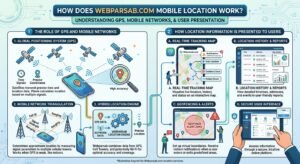
Mobile devices do not depend on one universal method to determine location. Modern Android devices can combine information from GPS, Wi-Fi, cellular networks, and sensors to estimate a device’s position. Google explains that combining these sources can help devices determine location more quickly and accurately, particularly when GPS signals are weak or obstructed.
This means a location service generally depends on an underlying technology or authorized platform that has access to relevant location information.
The Role of GPS and Mobile Networks
GPS is one of the best-known technologies used for mobile positioning. Satellites provide signals that allow compatible devices to calculate their position.
Mobile networks provide another source of location information. A phone communicates with nearby cellular infrastructure, and network-based information can contribute to estimating where the device is.
Google explains that Android’s Location Accuracy can use GPS, Wi-Fi, and mobile cellular networks together with device sensors.
How Location Information Is Presented to Users
Once a device or authorized service has calculated a location, the information may appear on a map or as an approximate location.
Google Maps, for example, uses a blue location marker to indicate a device’s estimated position. Google explains that a wider circle around the marker indicates greater uncertainty, while a smaller circle indicates greater confidence in the displayed position.
What Is Webparsab.com Mobile Location Used For?
Common Uses of Mobile Location Services
Mobile-location technology has many legitimate applications. People use location features for navigation, finding lost devices, sharing their position with trusted contacts, and accessing location-based applications.
Webparsab.com’s location specifically discusses Google Location Sharing, mobile tracking applications, WhatsApp Live Location, and other approaches to location tracking.
Location-Based Information and Services
Many smartphone applications depend on location information to provide useful features. For example, navigation applications need to know where a device is located to provide directions. Location-sharing services use location information to show a user’s position to selected contacts.
Android explains that applications with the appropriate permissions can use a device’s location to provide location-based features.
Understanding the Practical Uses
For someone researching Webparsab.com mobile location, the key point is to understand the difference between legitimate location technology and exaggerated online claims.
A legitimate location service normally has a defined method for obtaining location information. It may depend on the user’s device, GPS, network signals, an authorized application, or a location-sharing feature.
How Accurate Is Webparsab.com Mobile Location?
Location accuracy depends on several factors. GPS reception, Wi-Fi availability, cellular signals, buildings, environmental conditions, device hardware, and software settings can all influence a location estimate.
Google explains that combining different wireless signals and device sensors can improve location estimates, especially indoors or near large buildings where GPS signals may be obstructed.
GPS and Network Accuracy
Different location technologies can provide different levels of precision. GPS can be highly useful when satellite signals are available, while Wi-Fi and cellular information can help when GPS is weak or unavailable.
Google Maps explains that GPS can determine a location to around 20 meters under suitable conditions, while mobile-tower positioning can be considerably less precise.
Therefore, users should always treat a location result as an estimate whose accuracy depends on the technology and circumstances.
Why Location Results May Vary
A phone inside a building may produce a different result from the same phone outdoors. Tall buildings, underground areas, weak signals, disabled location settings, battery-saving features, and other environmental or device conditions can affect location quality.
Google Maps specifically identifies weak GPS or Wi-Fi signals, buildings, and certain device settings as possible causes of inaccurate location results.
Does Webparsab.com Mobile Location Require Permission?
Modern smartphones provide users with controls over which applications can access location information. Android supports both approximate and precise location permissions. According to Google’s current Android documentation, approximate location provides a broader estimate, while precise location provides a more detailed estimate when the user grants the relevant permission.
Why User Consent Matters
Location information can reveal where a person is and where they regularly travel. That makes responsible handling of location information important. Webparsab.com’s own says that location tracking should be performed legally and ethically. The safest approach is therefore to use location services with the device owner’s knowledge and consent.
Device Location Settings
Android gives users control over location settings and individual application permissions. On Android 12 and later, users can allow an application to receive approximate location rather than precise location. Google also explains that if the device’s location setting is disabled, apps and services cannot obtain the device’s location through the normal location system. These controls give users an important layer of privacy.
Is Webparsab.com Mobile Location Safe?
The safety of any location-related service depends on what it actually does, what information it requests, and how it handles user data.
Webparsab.com’s own warns that mobile-number tracking websites and applications may not always be reliable. It encourages users to use legitimate approaches instead of blindly trusting tracking claims. That is an important consideration for anyone researching Webparsab.com mobile location.
Protecting Personal and Location Information
Users should avoid giving unnecessary personal information to unfamiliar services. A website asking for a phone number does not automatically have the technical ability to retrieve the phone’s GPS position. The service must have an appropriate technical mechanism and authorized access to location information.
Users should therefore be cautious when a website promises an exact live location without clearly explaining how that information is obtained.
What Users Should Check Before Using the Service
Before using a location-related website or application, check:
- What the service actually does.
- What information it requests.
- Whether it requires location permission.
- Whether it explains its privacy practices.
- Whether its claims are technically realistic.
- Whether the intended use respects the other person’s privacy.
These checks can help users avoid misleading services and unnecessary exposure of personal information.
Webparsab.com Mobile Location and Privacy
How Location Data Can Be Sensitive
Location information can reveal a person’s movements and activities. Android therefore gives users control over the amount of location information an application can receive. Users can choose an approximate or precise location on supported versions of Android.
Understanding Privacy Policies
A privacy policy can help users understand how a website handles information. When evaluating a location-related service, readers should look for information about data collection, storage, sharing, retention, and user choices. This is especially important when a service involves information that could identify a person’s device or location.
Tips for Protecting Location Privacy
Users can take several simple steps to reduce unnecessary location exposure:
- Review location permissions regularly.
- Give precise location access only when necessary.
- Prefer approximate location when precise information is not required.
- Avoid entering unnecessary personal information into unfamiliar websites.
- Use trusted location-sharing services when sharing your position.
- Do not attempt to track another person without appropriate permission.
Android’s current permission system specifically allows users to choose between approximate and precise location access.
Benefits of Webparsab.com Mobile Location
Convenience and Accessibility
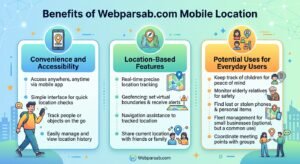
Mobile-location technology can make everyday digital services more useful. Navigation, location sharing, finding devices, and other location-based features can save time and provide practical assistance.
Location-Based Features
Location information can support many common smartphone functions. For example, Google Maps uses location information to show where a device is and provide navigation. Android’s Location Accuracy system can combine multiple signals to improve the location estimate.
Potential Uses for Everyday Users
For everyday users, some of the most practical uses include:
- Finding a lost personal device.
- Sharing a current location with a trusted person.
- Getting navigation directions.
- Using applications that depend on location.
- Understanding where a device was recently located when supported by the relevant service.
These uses are different from secretly obtaining another person’s location from a phone number.
Limitations of Webparsab.com Mobile Location
Accuracy Limitations
No mobile-location system should be treated as perfectly accurate under every condition. Google explains that GPS, Wi-Fi, cellular networks, and sensors can contribute to location estimates, meaning accuracy depends on which sources are available.
Device and Network Dependence
A location service may depend on the device having suitable hardware, enabled settings, available signals, and the necessary permissions. If GPS is obstructed or wireless signals are weak, the resulting estimate can become less precise.
Privacy and Security Considerations
Location information should be treated carefully because it can reveal sensitive information about a person’s movements. Users should understand what a service does before providing access to location information and should avoid questionable services that make unrealistic promises.
Why Users Should Avoid Unrealistic Expectations
One of the most important things to understand about Webparsab.com mobile location is that a phone number is not automatically a precise GPS locator.
Webparsab.com’s own states that tracking a location using a mobile number is not as simple as entering a number and immediately receiving a location. It explains that different technologies and tools are involved and that telecom network information is not simply available to ordinary users.
How to Use Webparsab.com Mobile Location Responsibly
First, understand whether you are reading informational content or using an actual location service. Webparsab.com’s published posts provide information about different ways mobile location can be tracked or shared. It should not automatically be interpreted as proof that the website itself can retrieve any phone’s private location data.
Understand Permissions and Requirements
If a location application requests access to your device, read the permission carefully. Android allows users to choose approximate or precise location access, giving them greater control over how much location information an application receives.
Avoid Sharing Unnecessary Personal Information
A location service should not be given more information than it genuinely needs. Users should be particularly cautious about sharing passwords, financial information, identity documents, or other sensitive data with an unfamiliar tracking website.
Use Location Services Responsibly
Location technology should be used for legitimate purposes and with appropriate consent. Webparsab.com’s own blog emphasizes legal and ethical tracking and discusses consent-based services such as Google Location Sharing and WhatsApp Live Location.
Read more: Technewztop 3D Explained: Features, Uses, and Benefits
Webparsab.com Mobile Location vs. Traditional Location Methods
Mobile Location Technology
Modern smartphone location technology combines several sources. Android’s Location Accuracy can use GPS, Wi-Fi, cellular networks, accelerometers, gyroscopes, and barometers when available.
GPS-Based Location
GPS uses satellite signals to help a compatible device estimate its location. It can be highly useful outdoors, but its performance can be affected by buildings and other obstacles. Google Maps notes that GPS may be inaccurate indoors or underground.
Network-Based Location
Network-based location can use cellular towers and Wi-Fi information to help estimate where a device is. Google identifies Wi-Fi and mobile cellular networks as sources that can contribute to Android’s location estimation.
Key Differences Users Should Understand
The key difference is that modern mobile-location services generally rely on authorized access to location information. They should not be confused with the idea that anyone can enter a mobile number into an arbitrary website and automatically retrieve that phone’s exact live GPS position.
Final Thoughts
The phrase Webparsab.com mobile location is closely connected to the topic of mobile-number tracking and location technology. Webparsab.com has published information about different ways mobile location can be tracked or shared, including GPS, mobile networks, Google Location Sharing, tracking applications, and WhatsApp Live Location.
At the same time, it is important not to confuse informational content with a verified proprietary tracking system. The available Webparsab.com material does not establish that the website can independently reveal the exact real-time location of any phone simply from its mobile number.
FAQs About Webparsab.com Mobile Location
What Is Webparsab com Mobile Location?
Webparsab com mobile location refers to Webparsab.com’s content about mobile-number tracking and mobile-location technology.
How Does Webparsab com Mobile Location Work?
Webparsab.com discusses several location technologies, including GPS, Wi-Fi, cellular networks, and device sensors. It does not establish that the website itself can provide an exact live location from a mobile number.
Is Webparsab com Mobile Location Accurate?
Location accuracy depends on the device, available signals, technology, environment, and permission settings.
Does Webparsab com Mobile Location Require Permission?
Location-based apps generally require appropriate device permissions. Android lets users control approximate or precise location access.
Is Webparsab.com Mobile Location Safe?
Users should be cautious with location-tracking services and avoid unfamiliar websites that make unrealistic claims or request unnecessary personal information.
Can Mobile Location Be Used Without GPS?
Yes. Smartphones can also use Wi-Fi, cellular networks, and device sensors to estimate location.
How Can I Protect My Location Privacy?
Review location permissions, use approximate location when possible, avoid untrusted tracking services, and share your location only with trusted people or services.